
Investing in Bali in 2026: opportunity or bubble?
Everyone is talking about Bali.
Investors, content creators, agencies…
The term “ROI” is everywhere. So are the promises.
But one question remains crucial:
Is investing in Bali today still an opportunity… or already a bubble?
The answer is simple.
👉 Both.
It all depends on one key factor:
where you invest.
Southern Bali: A Mature Market
Canggu, Uluwatu, Seminyak.
These areas have experienced exceptional growth in recent years.
They have attracted massive international demand, driven by tourism, digital nomads, and investors.
Today, the situation has changed.
In fact, several analyses of the Balinese real estate market confirm this trend of gradual saturation in the south (according to industry reports such as those from the Bali Business Club and Knight Frank Indonesia).
A density that reached a critical level
Development has accelerated rapidly. The result: a high concentration of villas, hotels, and similar projects.
👉 More supply = pressure on prices
👉 More competition = less stable profitability
According to several local studies on the rental market in Bali, the proliferation of listings on platforms like Airbnb has significantly increased competition in these areas.
The logic of a saturated market
Southern Bali is now a “mature” market. With very high land prices, limited land availability and an ROI under pressure.
As Knight Frank highlights in its analyses of emerging markets, rental yields in heavily developed areas automatically stabilize or even decline as supply increases.
Opportunities still exist, but they are rarer, riskier, and often already “priced in.”
An experience that loses its authenticity
Tourism is evolving.
A growing number of travelers are no longer looking for crowded areas, noise or standardized environments.
But rather:
👉 tranquility
👉 nature
👉 a local experience
This trend is widely confirmed by reports from the World Tourism Organization (UNWTO), which highlights the rise of sustainable and experiential tourism.
And this is precisely where the market is shifting.
Northern Bali: A Growing Market
Unlike the south, northern Bali is currently at the beginning of its cycle.
Areas such as Amed, Tulamben, and Lovina offer a very different landscape.
👉 Lower density
👉 Prices that are still affordable
👉 Rapidly growing demand
A trend of structural growth
The development of the north is not just a passing trend.
It is based on several solid factors:
The expansion of tourism into less crowded areas
Growing interest in ecotourism and extended stays
Major infrastructure projects, including a new airport planned for northern Bali
This project is regularly mentioned in regional development plans and in the Indonesian business press (according to the Jakarta Post and Indonesia Investments).
This type of infrastructure radically changes a region’s accessibility. And historically, it has been a direct catalyst for value appreciation.
The Key Role of the “Coconut Tree Law”
Bali has a single rule: No building may exceed the height of a coconut tree (approximately 15 meters).
This point is fundamental.
This regulation, enshrined in Bali’s local urban planning rules (RTRW), deliberately limits vertical development.
Unlike other destinations, development cannot be vertical.
It is horizontal.
👉 No high-rises
👉 No extreme densification
👉 Gradual expansion of the territory
The result is that areas near the sea are quickly becoming scarce, the development naturally spreads to new areas that are still underdeveloped, resulting to an increasing in value.
This is exactly what is happening today in the North.
A natural market growth curve
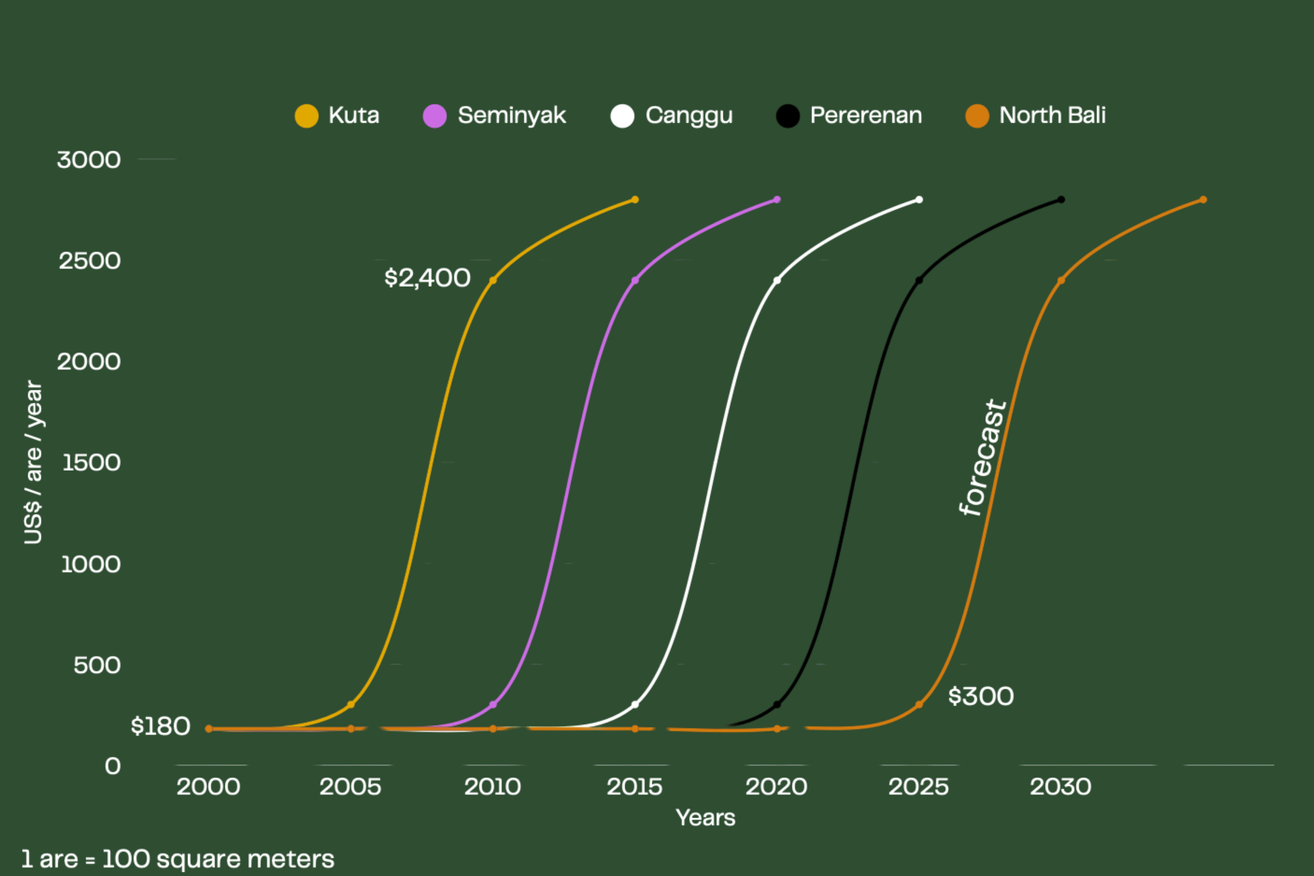
Graph from Bali Business Club
Development in Bali follows a simple pattern:
Saturation of an area
Shift in demand
Expansion into a new area
Kuta → Seminyak → Canggu → North Bali
This pattern of expansion is seen in many international tourism markets, particularly in Thailand and Mexico (according to McKinsey Travel & Hospitality Insights).
Today, the North (in orange on the graph) is in early stage.
👉 Demand is arriving
👉 Supply is still limited
This is where the best opportunities arise.
Amed: A rare balance between appeal and potential
Among the northern regions, Amed clearly stands out.
It’s not a mainstream destination. And that’s precisely what makes it so special.
An exceptional natural environment
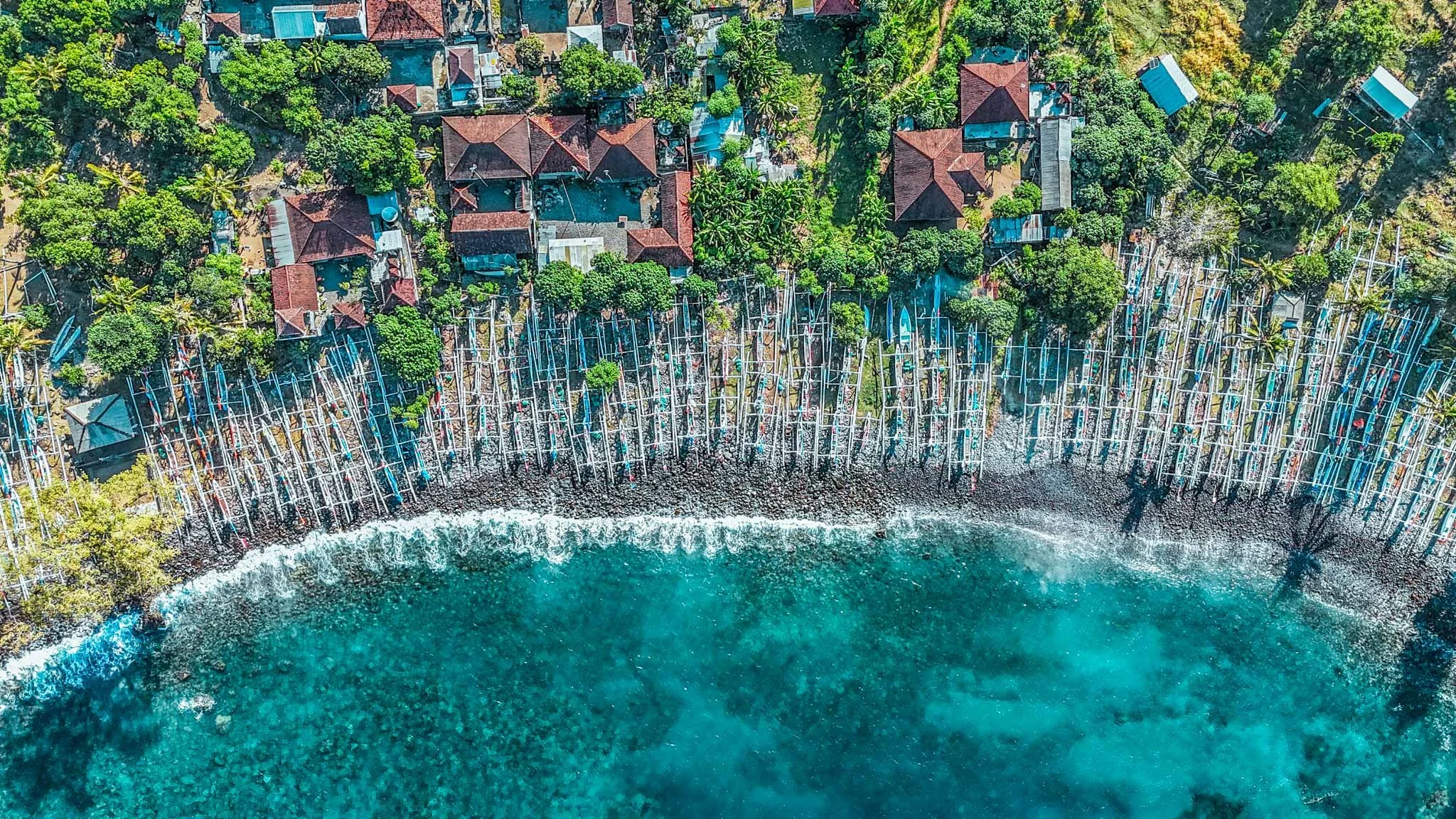
Amed offers everything many people are looking for today:
Views of volcanoes
Direct access to the ocean
World-renowned dive sites
Unspoiled rice fields and landscapes
👉 A setting that remains untouched
👉 An authentic experience
Northeastern Bali is particularly renowned for its dive sites, such as the USAT Liberty in Tulamben, ranked among the best spots in the world (according to PADI – Professional Association of Diving Instructors).
A rapidly growing tourism destination
Amed attracts a specific type of visitor:
long-stay travelers
divers
“slow travel” enthusiasts
investors seeking meaningful opportunities
This type of clientele offers two advantages:
👉 more stable
👉 higher quality
This shift toward longer, more immersive stays is also confirmed by Booking.com and Airbnb trends regarding post-COVID traveler behavior.
Opportunity or bubble: the real story
To say that “Bali is a bubble” is an oversimplification.
👉 Some areas are.
👉 Others are still in a phase of opportunity.
The real challenge isn’t investing in Bali.
It’s knowing where, when, and how to invest.
Our approach: investing with precision, not volume
At Black Sand Group, our vision is simple:
👉 We don’t aim to take on a large number of projects
👉 We aim to create coherent, sustainable, and well-managed investments
We operate exclusively in Northeast Bali, with an approach that is:
tailored to each investor
local, with a permanent on-the-ground presence
selective, with a limited number of projects
Each investment is designed as a long-term asset:
✅ land selection
✅ villa design
✅ rental strategy
✅ operational management
In short, in 2026, Bali remains an opportunity.
But not everywhere.
❌ The south is a mature market, showing signs of saturation.
✅ The north is a growing market, with untapped potential.
The difference between an opportunity and a bubble doesn’t lie in the country itself.
It lies in the area you choose.